Among the many markers of human intelligence, we view ourselves as superior to other primates in geometric intuition. We readily distinguish regular geometric shapes with features like parallel sides, symmetry, and right angles from irregular ones. Even Indigenous people without formal math education demonstrate core knowledge of geometry, such as in a study of the Mundurucu of the Amazon.
Scientists hypothesize that our geometric intuition stems from interpreting shapes using a symbolic system. That is, we cognitively parse a shape into its parts—angles, lines, and points—which allows for keen discrimination of irregularities. An alternative hypothesis purports that the human advantage originates from our ability to abstract and integrate information, such as recognizing a familiar shape in a new context.
A study published today in Proceedings of the National Academy of Sciences tested whether humans categorically differ from other primates in geometric intuition, or whether we fall along a continuum.
Read more: “The Cosmopolitan Ape”
A team of psychology researchers conducted shape-matching tests on touchscreen monitors with four participant groups: rhesus macaques, olive baboons, United States preschoolers, and Indigenous Tsimané communities in Brazil. In each trial, the primate—human or otherwise—had to touch a small white rectangle to signal readiness to begin the task. Then, in a series of trials, participants were shown a geometric shape and challenged to find its best match from a set of alternatives that varied in size, regularity, and degree of rotation relative to the original.
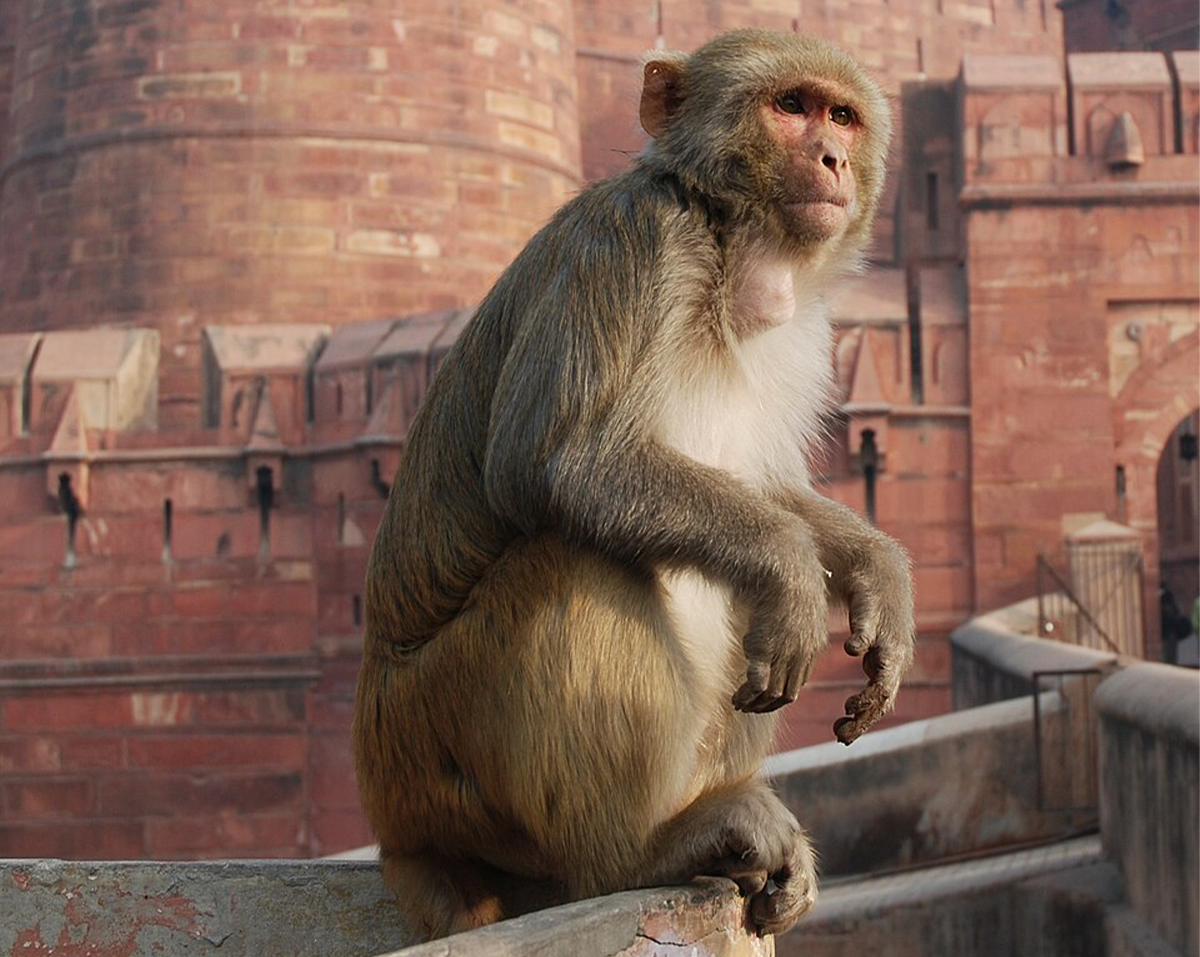
The results showed that human geometric reasoning isn’t categorically distinct from that of macaques or baboons. “Instead of a categorical divide, we find that monkeys and humans share a common representational space,” wrote the study authors, “relying on perceptual codes with graded contributions from abstract or symbolic-like features.”
Both the preschoolers and Indigenous adult participants were more accurate overall in the tasks, but monkeys were sensitive to geometric features like symmetry and parallelism. And so, our advantages in geometric intuition can be ranked along a shared, overlapping continuum with the monkeys.
Or as the researchers concluded, “The roots of geometric intuition extend deeper into primate cognition than a uniquely human symbolic faculty would predict.” 
Enjoying Nautilus? Subscribe to our free newsletter.
Lead image: Thomas Schoch / Wikimedia Commons